
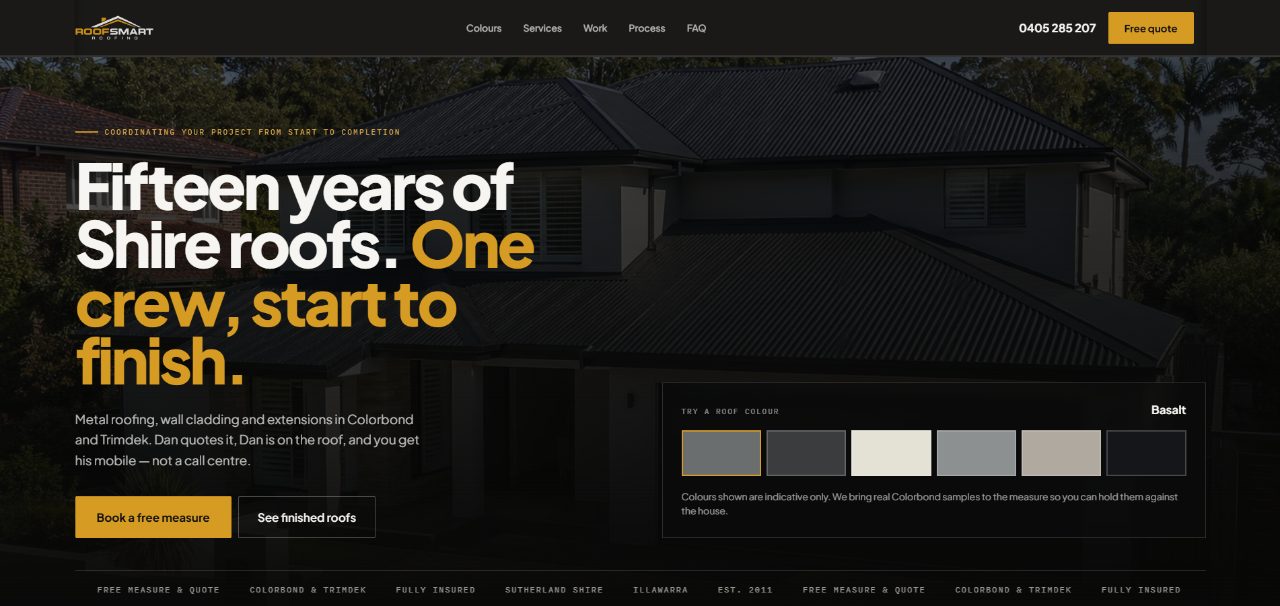
A good tradie website says what you do, where you work and how to reach you in the first screen on a phone. Behind that it needs one page per service, a page for each area you cover, real job photos, your licence details and a short enquiry form. Most other things can wait.
Websites for tradies fail in a very ordinary way. Somebody paid for one years ago, it has a nice photo of a ute, and the phone number takes two scrolls to find. The customer standing in a wet kitchen does not read your story. They want to know if you do this job, if you come to their suburb, and whether you look real.
Everything below follows from that. It applies to plumbers, sparkies, roofers, builders, landscapers, painters and anyone else who gets paid to turn up.
What should a tradie website have on it?
Fewer pages than most people are sold, and each one doing a clear job:
- A homepage with your trade, your area and a tappable phone number on the first screen.
- One page per service, written the way a customer describes the problem. People search for a blocked drain, not for drainage solutions.
- A page for each area you really work in, with a job or two from that area.
- A gallery with the suburb and the job in each caption.
- An about page with your name, your face, your licence and your insurance.
- A contact page with a form that asks for name, phone, suburb, the problem and a photo.
What does a tradie website cost?
I am not going to print a number, because the honest answer depends on how many services and areas you need written up and whether you already have photos. A five page site and a thirty page site are different jobs. What I would watch is the ongoing side. Ask who owns the domain, who owns the site if you stop paying, and what the monthly fee covers. Some cheap monthly deals leave you with nothing when you leave.
If you want a figure for your business, send a short brief and you get a written reply with scope and a price.
Do you need a separate page for every suburb?
No. Pages that only swap the suburb name are near copies, and they give neither Google nor the customer a reason to care. Group the areas the way locals talk about them, and only write a page where you can say something true. Our city guides show how that grouping changes from place to place, from Sydney's regions to Canberra's districts and Auckland's sides of the harbour.
How do AI tools like ChatGPT and Claude find a tradie?
They read the web much as a careful person does, and they need plain facts they can repeat. No site can force a recommendation, and anyone selling that is guessing. You can make yourself easy to read, though:
- State your trade, your service area and your licence number in normal text, not inside a picture.
- Answer common questions in a sentence or two at the top of a page. AI tools quote short, self-contained answers.
- Keep your name, address and phone number identical on your site, your Google Business Profile and any directories.
- Let the search crawlers in. A robots file that blocks them keeps you out of their answers.
- Collect reviews on other sites. A tool that sees your name elsewhere has more reason to trust what your own site says.
That list also helps with ordinary Google results, so none of the effort is wasted if AI search changes again next year.
What makes a tradie website slow, and does it matter?
Most of your visitors are on a phone, and some are on patchy mobile data. Huge gallery photos and heavy sliders are the usual cause of a slow site. Resize photos before they go up, drop the slider, and test the page on your own phone away from wifi. If it takes long enough for you to get annoyed, your customer has already gone back to the search results.
Common questions
Yes, because people look you up after a referral. A plain site with real photos and a working phone number confirms what the neighbour said. A missing or abandoned one gives them a reason to ask someone else instead.
It helps people who already know you, but it does little for someone searching for a service in their suburb. You also do not control the page. A small website you own, linked from your Facebook page, covers both groups.
It can appear within days, but ranking for useful searches often takes months, and I would plan on around six. Smaller, specific searches usually move first. Nobody can honestly promise a position or a date, whatever their sales page says.
Exact prices rarely work when you have not seen the job. A typical range for a common small job, or a list of what pushes a price up, still helps. It filters out poor fits and shows a customer you are upfront.
You can, and a simple one you finish beats a fancy one you never start. The hard part is usually the writing and the photos, not the software. Get help when the site starts costing you more in lost calls than it saves.
If your site is not bringing in calls, send a short brief and I will reply in writing with what I would change first. If you work in one city, start with its guide: Melbourne, Brisbane or Perth.